A continuous evidence chain
Conversation, transcript, suggestion and human decision form a continuous chronology that is never silently overwritten.
Gewerkton Operations
Beta
With handover the customer changes: no longer site management, but the owner, the property manager or facility management. Operations turns the closing into a continuation. This line is built and in beta; it has not been in use at a customer yet.
The building
At handover the project becomes an entity of its own: the building or the asset, with a reference to the history of the construction phase. The evidence is not copied; the chain stays one.
What is builtHandover
If another organisation manages the finished building, it is handed over by invitation. The building organisation keeps its project and can archive it later.
What is builtWarranty
A reporting path leads from the user through the operator back to the building organisation. A case arrives there with the reference to the original evidence chain, instead of as a shout.
This is the state of the software: all beta, not yet in use at a customer.
An entity of its own for building and asset, with a reference to the construction phase.
Handover record, asset register, room book and deadlines travel along.
Deadlines per trade and acceptance, with suggestions for walkthroughs.
Recurring inspections such as ventilation, lift and fire protection are kept on the building.
A maintenance job is evidenced like any other item: checklist, photo, signature.
Assets, documents and history in one place and searchable.
Operations is not a full CAFM. Space management, contracts and keys stay out of scope; for existing CAFM systems there is the export. All beta; this page says nothing about approval or legal effect.
These capabilities are built and tested. They have not been in use at a customer yet: 2026 is the beta year, general availability is planned for 2027.
For every warranty period taken over, Operations calculates an inspection date some weeks before it ends and proposes it. If it falls on a weekend, it moves. People walk the building and decide.
The handover to the building manager copies, it does not move. Photos and records stay in the construction documentation, the operator receives references with a checksum and sees only what was handed over. That separation sits in the database, not in a setting.
Three paths run over simple links that work on any phone and speak the language they are given: the QR sticker in the hallway for tenants, the warranty report back to the building company, and the maintenance report from an outside firm.
For every deployment the daily value of the chosen weather station is recorded. Years later it can be shown what the day was really like.
Move in and move out are recorded room by room with photos. On move out, Operations puts the pictures from back then beside them.
A selection, not a feature list. What stands here exists in the product; what does not stand here is neither promised nor ruled out.
Evidence over rank: every step from the spoken word to approval stays traceable, while a suggestion never takes effect on its own.
FIDIC, AIA, ConsensusDocs, JCT, VOB and custom frameworks are versioned. Chops, hanko, dojang and company stamps are recorded only as technical confirmations, with no claim of special legal effect.
Conversation, transcript, suggestion and human decision form a continuous chronology that is never silently overwritten.
Before evidence protects client and contractor alike. Companies can challenge scorecards; site management records the decision.
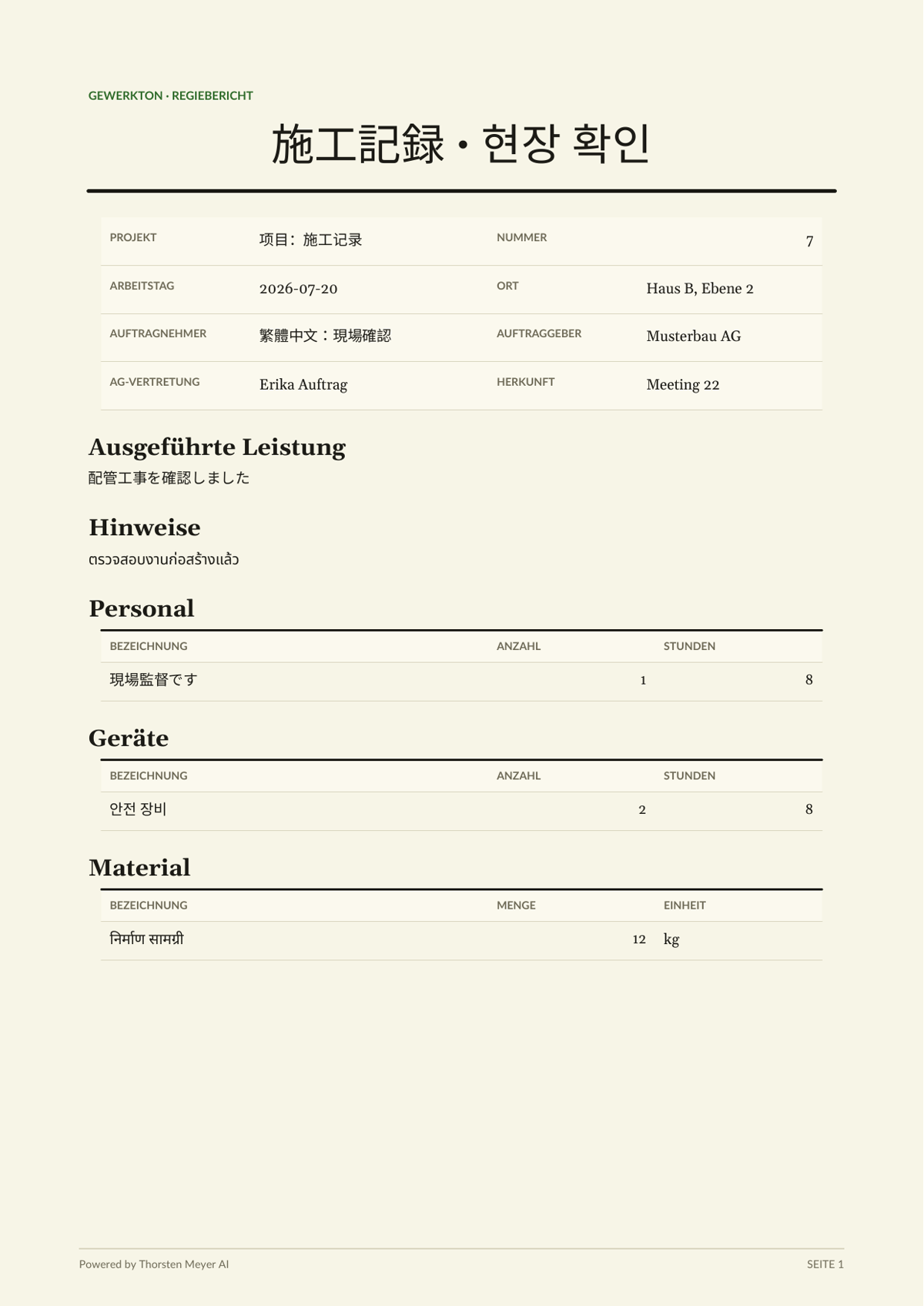
Embedded Noto fonts render Chinese, Japanese, Korean, Thai and Devanagari correctly in PDF reports.
Operations is in beta. If you take over buildings and want to shape the reporting path early, join through the waitlist.
Request access now