A continuous evidence chain
Conversation, transcript, suggestion and human decision form a continuous chronology that is never silently overwritten.
Gewerkton Archive
Beta
When a project ends, the duty to prove does not. Archive turns the closing into a lasting state: readable, exportable, unchangeable. This line is built and in beta; it has not been in use at a customer yet.
Lasting state
Next to active and suspended there is a third state: archived. With no deletion clock running, and with read access and search for permitted roles. The way back into the active state is possible and logged.
What is builtWrite lock
Instead of many separate rules there is one central lock: for an archived project every writing path refuses, with a clear message in the content languages.
What is builtIntegrity
A yearly run holds the checksums of the evidence chain against the originals and files the result as a report with a timestamp. If something deviates, it is reported rather than passed over in silence.
This is the state of the software: all beta, not yet in use at a customer.
A lasting state with no deletion clock, next to active and suspended.
Permitted roles read, search and pull exports, even years later.
One gate at the entrance instead of a separate rule per table.
One report per archived project, with a timestamp through the existing mechanics.
Originals stay byte identical; only the storage class gets cheaper. Retrievals from cold storage can take minutes.
The way back into the active state is documented and traceable.
Archive is reading. Deadlines, inspection cycles and reporting paths after handover belong to the Operations line. All beta; this page says nothing about approval or legal effect.
These capabilities are built and tested. They have not been in use at a customer yet: 2026 is the beta year, general availability is planned for 2027.
An archived project can no longer be changed, deleted or added to afterwards: not by your own admin and not by us as the provider. Once a year the archive recalculates every checksum and files the result with a timestamp.
Before archiving, the closing assistant says plainly what is missing: defects without a closing photo, notices never sent, company access still open. The completeness value is frozen along with the rest.
For one defect a package is created from photos with checksum and date, correspondence, deadlines and the plan reference. One document instead of three days in the folder basement.
The holdings come with an index of every file, a checking tool for the browser that needs no server and no account, and a letter explaining in plain language what the holdings are. The other side can recalculate a checksum themselves.
A question about the holdings is only answered where a record backs it, with the place it was found. If none does, the answer says so and does not guess.
A selection, not a feature list. What stands here exists in the product; what does not stand here is neither promised nor ruled out.
Evidence over rank: every step from the spoken word to approval stays traceable, while a suggestion never takes effect on its own.
FIDIC, AIA, ConsensusDocs, JCT, VOB and custom frameworks are versioned. Chops, hanko, dojang and company stamps are recorded only as technical confirmations, with no claim of special legal effect.
Conversation, transcript, suggestion and human decision form a continuous chronology that is never silently overwritten.
Before evidence protects client and contractor alike. Companies can challenge scorecards; site management records the decision.
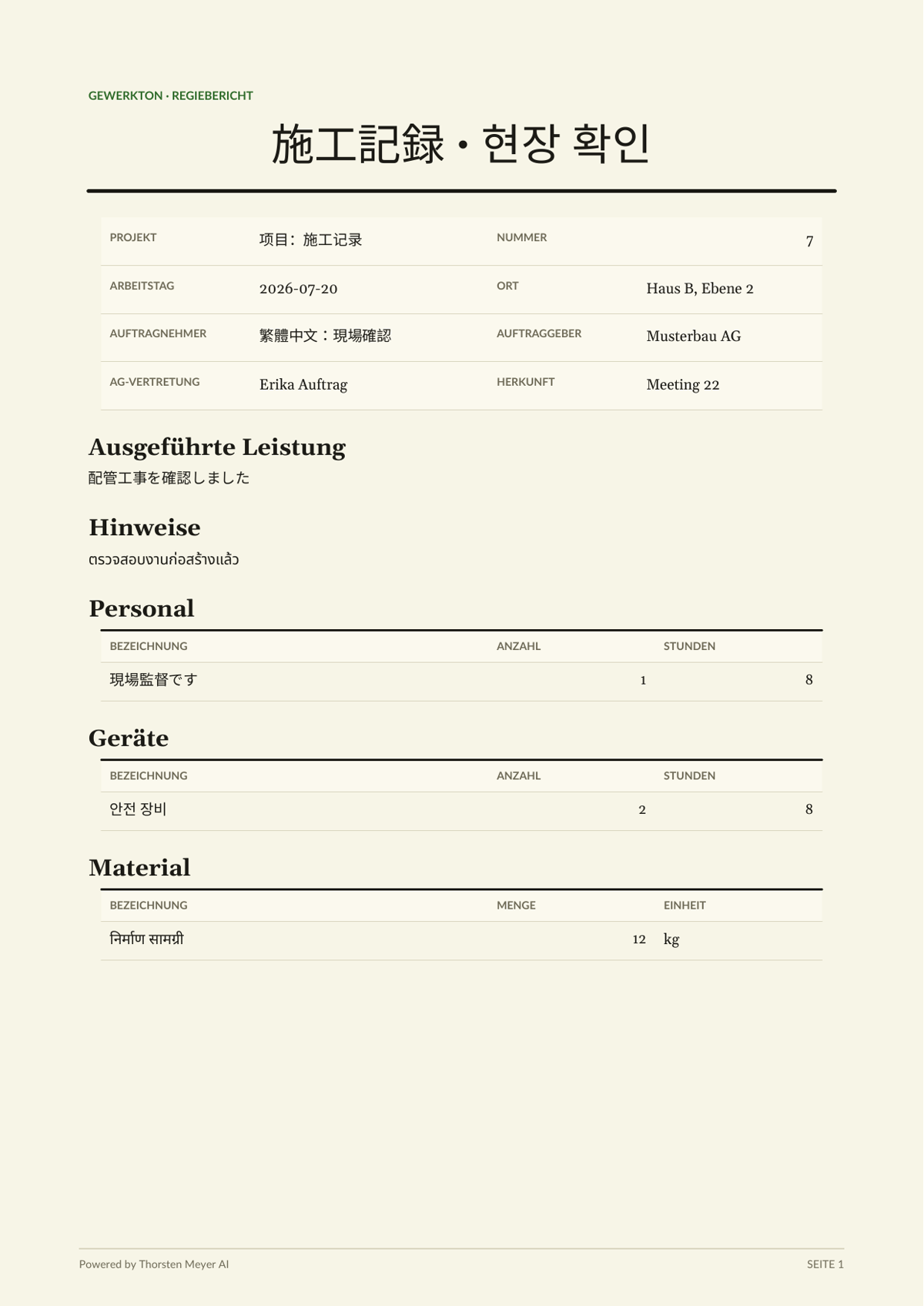
Embedded Noto fonts render Chinese, Japanese, Korean, Thai and Devanagari correctly in PDF reports.
Archive is in beta. If you want to freeze your own records early and have them recalculated every year, join through the waitlist.
Request access now